Smart Doesn’t Mean Everywhere at Once-A Practical Phased Plan
Smart Doesn’t Mean Everywhere at Once — A Practical Phased Plan
Kore Solutions works with organisations that want smarter, more resilient buildings - but not at the cost of disruption, unnecessary spend, or over-engineered solutions.
One of the biggest misconceptions we still see about smart buildings is that becoming one means doing everything at once. A full overhaul. New systems everywhere. A single, complex project that touches every corner of the building.
In reality, most successful smart buildings don’t arrive fully formed.
They evolve deliberately, in phases, and at a pace that makes sense for the building and the people using it.
The Big Misconception About Smart Buildings
For many organisations, the idea of a smart building feels overwhelming. Concerns usually include:
High upfront cost
Major disruption to day-to-day operations
Long implementation times
Technology becoming obsolete before it delivers value
That perception often leads to inaction - not because smart technology isn’t wanted, but because the perceived risk feels too high.
The reality is very different.
Most smart buildings are developed in phases, aligned to budget, operational priorities, and risk tolerance.
Smart isn’t about doing everything.
It’s about doing the right things first.
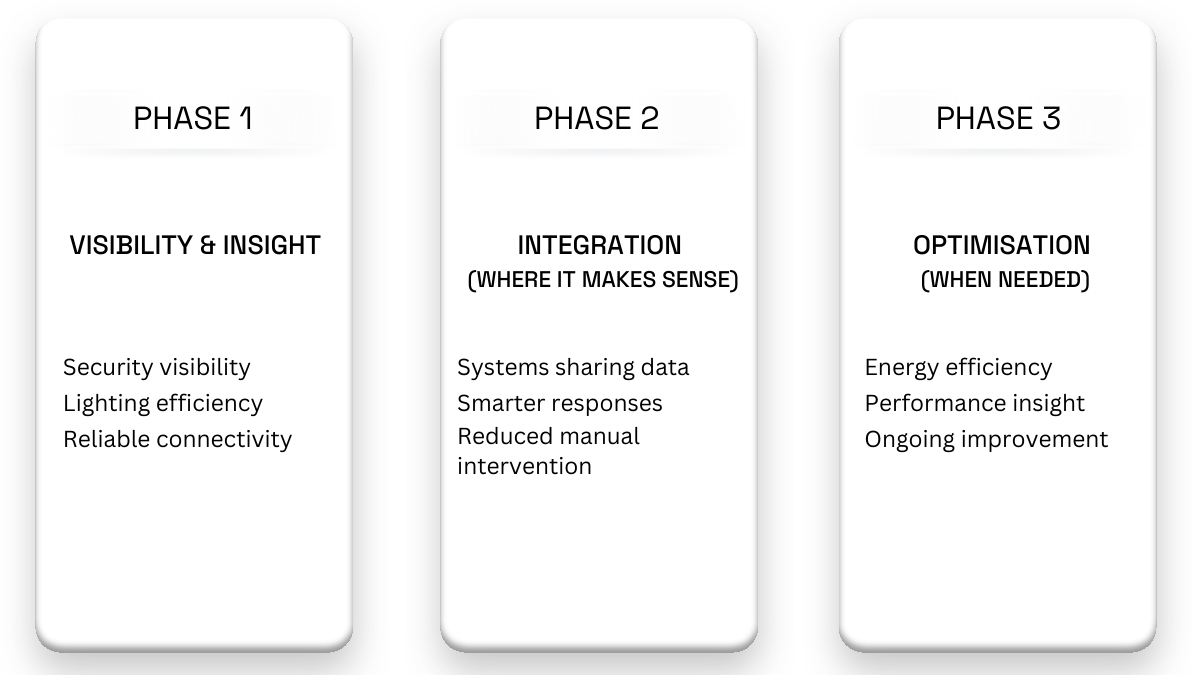
Start With Visibility, Not Perfection
A common mistake is to think automation should come first. In practice, the most effective starting point is visibility.
Before systems can optimise, automate, or adapt, building teams need a clear picture of what’s actually happening day to day.
Early-phase improvements often focus on:
Security visibility and alerts
Lighting efficiency and control
Reliable connectivity between systems
This creates a baseline:
What’s being used
What’s underperforming
Where inefficiencies or risks exist
You can’t optimise what you can’t see — and visibility alone often delivers immediate value.
A phased approach allows organisations to move forward without committing to unnecessary complexity.
The first phase of a smart building journey should stand on its own. Even if no further phases follow, the building should be better off.
Typical examples include:
Cloud-managed security systems
Smarter lighting controls in key areas
Targeted network upgrades to improve reliability
These upgrades are often chosen first because they:
Deliver clear operational benefits
Require minimal disruption
Improve control and responsiveness
Lay foundations for future integration
Crucially, this phase should not rely on future work to justify its value.
Phase Two: Integration Where It Makes Sense
Once individual systems are in place, additional value comes from selective integration.
This does not mean everything has to connect to everything else. It means linking systems where there is a clear operational benefit.
Examples may include:
Systems sharing data to improve responses
Reduced manual intervention
Better coordination between building functions
At this stage, “smart” becomes practical - supporting real decisions rather than adding complexity.
Phase Three: Optimisation (When Needed)
Automation and optimisation are often what people picture when they think of smart buildings - but they are most effective once strong foundations exist.
This phase may involve:
Energy efficiency improvements
Performance insight
Ongoing refinement over time
Importantly, not every building needs to reach this stage.
Smart maturity is about suitability, not scale.
For many organisations, stopping at phase one or two is enough.
What a Phased Approach Protects You From
A phased approach isn’t about slowing progress. It’s about reducing risk.
It helps organisations avoid:
Investing in systems that don’t integrate
Locking into platforms too early
Over-engineering solutions
Paying for features that won’t be used
Measured progress allows better decisions at every stage.
What Good Planning Actually Looks Like
A well-designed phased plan:
Starts with the building, not the technology
Considers integration without assuming compatibility
Balances quick wins with long-term flexibility
Accounts for future support and expansion
Experience matters here - not to push technology, but to know when not to.
Smart Is a Direction, Not a Deadline
Smart buildings are never truly “finished”. They evolve as organisations grow, regulations change, and technology develops.
The most successful projects are guided by:
Clear priorities
Honest advice
Phased, intentional decision-making
Smart doesn’t mean everywhere at once.
It means moving forward with purpose.